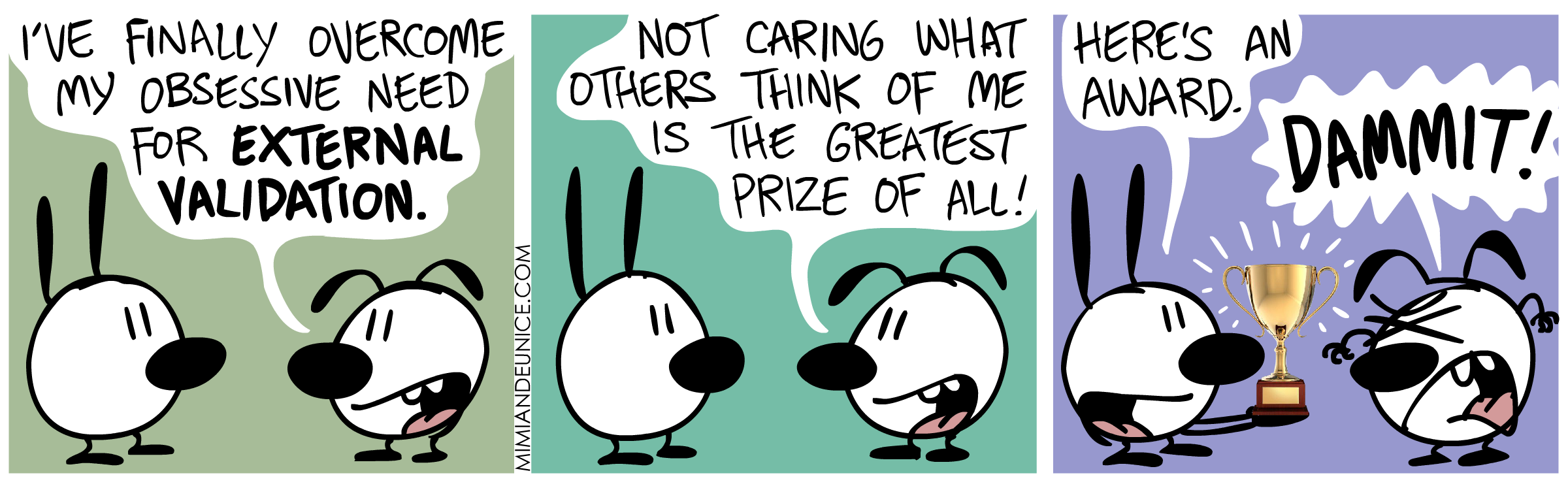
Sunday, March 13, 2016

Inner Voices of Doubt


Why Do We Doubt?

The fundamental cause of the trouble is that in the modern world the stupid are cocksure while the intelligent are full of doubt. -- Bertrand Russel

Often paraphrased as "The whole problem with the world is that fools and fanatics are always so certain of themselves, but wiser people so full of doubts."
My hypothesis is that 'doubt' is an evolutionary adaptation that keeps us safe from making really stupid mistakes.

I come to this conclusion after numerous discussion with people about the psychology of doubt. Usually this comes from people who have treated others, or been treated for dealing with the 'inner voices of doubt,' 'the committee,' or other terms, for example: Conquer Your Critical Inner Voice, by Robert Firestone, Lisa Firestone, Joyce Catlett, talks about 'the inner critic.'

People often talk about these battles of doubt as some sort of weakness or disability, but I think they have it backwards. I took a course in 'Resilience Training' a couple of years ago from the Sue Drinnan of the Wisdom Collective. One of the things we did was a self inventory of our strengths and over used strengths. Note, she called them 'over used strengths' not weaknesses.

An interesting branch of psychology is Evolutionary Psychology where we look at various psychological issues not as disabilities as conventional psychology and psychiatry do, but as evolutionary adaptations that do not serve as as well in a modern environment. For example, if we look at various 'attention disorders' in the light of early hunter/gathers living on the African plains, then hyper alertness may have been a benefit: constantly alert to prey or other predators--Squirrel!

I suspect that in a normal healthy mind doubt and confidence are in healthy balance. Indeed, there should be an inner turmoil, especially over important issues and decisions, between the perspectives of doubt and confidence. Sadly I know many people who struggle with self doubt, who feel disabled by it at times, and I do not want to invalidate such important feelings, to be sure they are very real and valid feelings, as I have struggled passionately with this at times. My perspective is that if we think about disabling doubt as an overused strength rather than a weakness, then our approach should be to harness that strength rather than eliminate a weakness.

In harnessing this strength, perhaps it is better to recognize, acknowledge, validate, and support it. I have said before, "the path to love is recognition, acknowledgement, validation, and support;" therefore to use this path on our doubts is to learn to love ourselves more, for who we are. Just as being able to 'speak the truth' is a great strength, there are times when it is not appropriate, it must be harnessed, and moderated with tact.

When I was a young child I used to be afraid to go to sleep at night because of the terrible nightmares I would have that would wake me in the middle of the night. The anxiety was ferocious. Somehow over time my dreams did not change, but they went from being frightening to simply entertaining. Perhaps this is a good way to thing about doubts or any 'disabling thoughts' is to accept them and be able to stand back from them as useful, but not crippling or dire.

To be sure, an important insight of Bertrand Russel is "that in the modern world" because it is the modern world that separates the intelligent from the stupid and cocksure. In the modern world we do not live an existence on the plains of Africa, where evolution quickly sorted out the stupid and cocksure. For example, in the 2016 American Presidential Election, one wonders how many of the myriad candidates would not have been eaten by lions and tigers first, before they had a chance live long enough to earn the merit for such an important role. For their supporters, one again wonders how many of them would have survived long enough in a dangerous world, while having little or no self doubt.

Just because the modern world seems to define confidence as success does not mean that confidence is a more important strength than doubt, it only means we are out of balance. For the most part, I would rather err on the side of doubt, as that is generally less dangerous to yourself and others, than errors on the side of the confident and cocksure.
As an aside, why do we say 'cocksure' and not 'pussysure' - or does pussysure simply mean to be sure some overconfident cock is talking nonsense. :-)
Just thinking out loud...

Monday, October 26, 2015

Ux Rx

User Experience Prescription


Today I had an especially bad experience at my doctor's office.

After thinking about it for a while I decided to analyze why the experience was so bad, and I approached it based on my past experience with User Interface Design, or as it is called these days User Experience (Ux) and Human Factors.


The Experience


Last week I received a phone call from my doctor's office that my blood test results were in, and my doctor 'urgently' wanted to see me. I asked when I should come in, and the caller said Monday. I asked if there was any specific time on Monday and the caller said "any time would be fine and she [the doctor] will just see me."

So today I show up about 11:00 AM and announce myself. The receptionist tells me to come back after 2:30 PM. I explain that I was told to come in anytime because it was 'urgent' so she looks up my file and says there is nothing urgent there. Note that this is a very invalidating response, because for most customer service staff, if anything is wrong, they almost always try to blame it on the customer, or someone else.

I explain that I have already paid for parking and she gives me that 'deer in the headlights' look that I also find frustratingly common with customer service staff. She then tries to tell me the doctor has a new policy in that there are no appointments and that people should just walk in, but I have to come after 2:30 PM. I explain that last week on the phone I was told to come in "any time." Again, that 'deer in the headlights' gaze makes me suspect there is very little empathy or compassion operating behind those eyes. She asks if I would like to come back at 2:30 and I say "No, just have someone call me when you can give me at time to come in" and I walk out.

I walk back in a few seconds later to add "I am really angry about this because it has happened several times now, so please tell the doctor to call me when she has time," then I leave.

A few minutes later after I have left I get a phone call from the regular receptionist who knows me quite well. She is very apologetic, and says I am a valued patient, and that some of the temporary staff don't know how to handle things well. Finally, she gives me a time to come in tomorrow, and I agree to come back then.


Root Cause Analysis


As a very experienced software developer I am accustomed to facing software, systems, and process defects on a routine basis. In general, after solving a problem I have learned to perform some sort of Root Cause Analysis of the problem in order to understand it, and hopefully prevent it from occurring again. Usually this is some twisted technical issue, but it applies equally well to User Experience issues.


Temporary Staff


The first part of the failure was 'temporary staff.' While the receptionist who saw me today was temporary, the regular receptionist also claimed that it was a temporary staff member who contacted me last week.

The basic problem with temporary staff is they are generally incompetent to do the job given because they do not have the experience to do it properly, or the attitude to do it well.


Staff Training


Staff training is a constant problem, especially for front-line people like receptionists who have to deal with other people. They are generally not trained well, and tend to be especially poor at dealing with people, especially frustrated people. Training is even less likely for temporary staff.


Business Processes, Ux, and Human Factors


The quality of a business is directly related to the quality of the processes the business uses. In most doctor's offices, making appointments with patients is the norm. It is not really important why my doctor implemented a policy of no appointments, but the failure was to consider how this change in a standard business practice would affect other business processes as well, in particular staff training and customer relations.

In most doctor's offices it is generally understood how to make an appointment, and what the process is. However, it is not well understood how other processes need to change when there is no appointment system. In particular, the staff need to be better trained to explain the new process to customers (patients), and the new process has to be tested and refined until the defects are worked out.

For example, if you are going to run a non-standard business process, then document it, and train your staff in how to implement it. For temporary staff, make sure they have the document, or at least a cheat sheet near them. When calling a patient, here is what you say... When responding to a patient, here is what you say...

For non-standard processes, there needs to be Quality Assurance process to make sure the non-standard process is giving you the result you want, and not giving you results you don't want, such as frustrated customers.


First World Problems


Check out the video above on First World Problems. Every business that has customers, clients, patients, etc. really should watch and understand these issues. The main problem is that most business contribute to these problems because they have no motivation to consider them. This is especially true in my field of technology with computers, mobile devices and web applications; but just as important with mature businesses such as a medical practice.


Great Doctors and Great Businesses


To be sure, I really have a great doctor. In fact, I chose her after researching various doctors on the web, and she had the highest ratings, and number of excellent patient testimonies. My medical experience with her also confirms she is an excellent doctor.

However, running a medical practice is more than just being a good doctor, it is also running a business. But having business experience is also not enough, as it is clear the most CEOs and other business leaders do not care about User Experience either. Having an MBa is only going to give you insight into increasing profit, it will never give you insight on the importance of Human Factors or User Experience Design.

I am not really sure what the answer here is, but I suspect it is related to First World Problems, and how people don't take these seriously. We often joke about first world problems, like "OMG, there is a fly in my wine" while in the back of our mind we know there are people starving around the world.

Basically, it is a first world problem that many business, including medical practices, do not take the time to fully understand the User Experiences of their customers or service users. This is a cross-cutting concern that everyone should study and understand in school, college, university, etc.

There are models for success. Consider Apple, for example. Much of the quality of Apple products and services is based on the fanatic perfectionism of Steve Jobs. Apple customers are some of the happiest, most satisfied, most loyal in the world. Largely this was because Steve Jobs actually used his own products and services, routinely had to demo them to other people, and would become passionately upset if something was less than perfect.

If you are responsible for any kind of product or services, try actually using that product or service the way your customers do. Talk to your customers, and ask them how your products and services are. Make it easy for them to give you feedback, and act on that feedback.

The Doctor

Thursday, February 27, 2014

The Daemon Dances


Have you ever been in a debate?

Was it good or bad for you?

Did you win or loose?

Was it a contest?
Debate is contention in argument; dispute, controversy; discussion; especially the discussion of questions of public interest in Parliament or in any assembly.[1]
Debate is a method of interactive and representational argument. Debate is a broader form of argument than deductive reasoning, which only examines whether a conclusion is a consequence of premises, and factual argument, which only examines what is or isn't the case, or rhetoric, which is a technique of persuasion. Though logical consistency, factual accuracy and some degree of emotional appeal to the audience are important elements of the art of persuasion, in debating, one side often prevails over the other side by presenting a superior "context" and/or framework of the issue, which is far more subtle and strategic. The outcome of a debate depends upon consensus or some formal way of reaching a resolution, rather than the objective facts as such. In a formal debating contest, there are rules for participants to discuss and decide on differences, within a framework defining how they will interact.
Debating is commonly carried out in many assemblies of various types to discuss matters and to make resolutions about action to be taken, often by a vote. Deliberative bodies such as parliaments, legislative assemblies, and meetings of all sorts engage in debates. In particular, in parliamentary democracies a legislature debates and decides on new laws. Formal debates between candidates for elected office, such as the leaders debates and the U.S. presidential election debates, are sometimes held in democracies. Debating is also carried out for educational and recreational purposes, usually associated with educational establishments. The major goal of the study of debate as a method or art is to develop the ability to debate rationally from either position with equal ease.
Although informal debate is common the quality and depth of a debate improves with knowledge and skill of its participants as debaters. The outcome of a contest may be decided by audience vote, by judges, or by some combination of the two.
― http://en.wikipedia.org/wiki/Debate
I have discovered there is another form of debate that I actually enjoy, and that is when two or more people discuss important issues, not as in a game of win or loose, but in a passionate exploration of facts, ideas and a journey, without destination, into new truths.

While I cherish these debates, they are few and far between on my journey through life. Sadly, all too often, most of the debates I end up in are the win/loose kind. What is even more sad is that I end up in these debates, when I really did not want to enter them at all, ever.

Once I was sitting in a park, along the ocean, chatting about the weather and other light topics with my girlfriend. Before I knew it, I was ensconced in a debate. Hold on, isn't “ensconced” supposed to have something to do with a safe place? My point was, I was feeling safe, in the park, on a grand day, sitting by the ocean, on the west coast of Vancouver Island, and suddenly I found myself “embroiled” in this debate about (gawd, I can't even remember any more).
Most people do not listen with the intent to understand; they listen with the intent to reply.
― Stephen R. Covey, The 7 Habits of Highly Effective People: Powerful Lessons in Personal Change

When Someone is Listening to Understand

  • They look relaxed
  • They nod their head a lot
  • They smile, that dreamy smile like they are enjoying what you say
  • They stop to paraphrase what they understand
  • They make short, clever, interjections to show they relate to what you are saying

When Someone is Listening to Reply

  • They look agitated
  • They shake their head sideways a lot
  • They grimace, or otherwise do not look pleased or content
  • They stop to interrupt and invalidate what you are saying
  • They try to hijack the entire conversation to their agenda
It's not rocket science, I can pretty much tell pretty soon which way things are going. What I cannot understand is why I cannot control myself better when the debate turn ugly.

Thinking, Fast and Slow

If you have not read “Thinking, Fast and Slow” by Daniel Kahneman, you should. In a nutshell, our minds tend to function in one of two modes:
  1. Thinking fast, when quick decisions are required, especially life or death.
  2. Thinking slow, when we have the luxury of reason, thoughtfulness, and reflection.
Whether or not we are in danger, there are some things are minds do very well, very quickly. For example, what is 3 times 7?

It is 21 of course because we memorized the multiplication tables in primary school, and the fast thinking part of our brain can remember that fact in an instant, whether we are in a crisis or not. OK, what is the square root of 856?

29.257 of course, because I used a calculator. However, I bet a lot of you thought WTF? How do you calculate square root? For those of you who know how to calculate square root, it is a long process, involving division and estimation, but it is certainly not a quick table look-up from childhood training. I could have done it without a calculator, but it would have taken me many minutes.

For some of you, you might even have felt “who is this fucking intellectual snob challenging me to some stupid esoteric bit of knowledge and reasoning? This bastard is some some holier than thou asshole trying to make me look stupid, and someone needs to put him in his place”

And there we have it. The slow thinking person might have actually parsed and tried to understand I was talking about slow thinking, whereas the fast thinking person might have been reacting instantly to their emotions, parsing half my words, and none of my semantics, reacting instantly to their passions, and thinking of how best to reply to my perceived insult to them.

Dance

I have been a swing dancer since the late 1990's and while I am not exceptional, I am experienced. As a dance lead you learn many many patterns―that is the core of your training. Along the way you also learn skills and techniques, and in particular you (try) to learn to listen to listen to the music in real-time, choreographing moves, and leading your partner into a successful experience or performance for both of you.

Dance is usually about thinking fast, because if you are not intimately familiar with the music, you need to improvise a lot, instantly, in real time.

I have experience more than my fair share of couples counselors and other so-called communications experts, who all say, it is better to discuss important issues face-to-face rather than in e-mail. To all those people I say: bull-fucking-shit, you are so out to lunch. Scientific research shows that people do not usually think rationally quickly. It is really hard to reflect and listen to understand quickly, especially when emotions are in play. I think it is more important to know when you can discuss things face-to-face rationally, and when some other form of communication is necessary.

When people, especially people with strong feelings, try to communicate, we become like dancers. When we hear the music of our emotions, we fall back into our dance patterns, and we either listen to understand or we listen to reply, based on the dances we are most comfortable with.

More recently I have become enchanted with Blues Dancing. What I feel compelling is that this form of dance is more about listening to the music, and interpreting what you hear. There are just not as many patterns to choreograph, and there is more emphasis on the conversation with your dance partner. Overall, there is more emphasis on the experience and less on the performance. Maybe there is some fundamental truth here to relationships, that there should be more emphasis on the experience of our relationships than on the performance of them.

There are daemons in all of us that drive us to react on our emotions instead of our reason. Communication is the most important dance any of us will know or experience in our lives. Until we learn to ignore the daemons in our emotions, we can never learn to dance to the true music of life. Any debate that is reactive instead of reflective, is just fear as opposed to love.

As I grow older and wiser, I am inclined to believe that love is more about reason than emotion, that is true love is about reason, while false love is about emotion.

The Daemon Dances

The Daemon Dances are those interactions we have with people where we fall back on past traumas and ineffectual responses, where we listen to reply, as opposed to listen to understand. In the end, is our choice to understand life, or reply to it?

And I leave you with Samba Pa Ti, one of the songs I feel is most about love. There are no words, just love. Maybe you will listen, and there will be no debate.

Saturday, August 31, 2013

Do You Validate Here?


Don't frown because you never know who's falling in love with your smile.
-- Xandra Moss, age 13

That quote is from the book "Tommy Transit's Bus Tales" by Tom Tompkins and Michele Hall. It pretty much sums up Tommy's mission in life, validating everyone he meets, finding ways to make each of us feel special, appreciated, visible, and validated.

I was once told, by a trained psychologist, that I should not require or expect validation from others, rather I should learn to self validate. Fair enough, that is sage advice, and I practice it when I can.

The problem with that advice is that life, our world, society can be incredibly invaliding at times. Every time I get into a phone menu system I feel dehumanized, my humanity is invalidated. I feel like I am treated like a robot, relegated to follow some script some junior programmer has concocted for me, who in turn was probably invalidated by his or her boss or company. To be sure, modern corporations, capitalism and consumerism are just machines that take human beings as input, and grind us up to extract profit for the small minority controlling the machines.

Even worse than phone menu systems are the ubiquity of web sites and web applications on the cloud that have automated the process of extracting profit from consumers, largely in a dehumanizing and invalidating way. I say this not as a lament, but as an expert option, for I am a software developer too, who has taught user interface design in a third year university course. I know with confidence that we can do better, we certainly know how to do better, we simply choose not to do better.

Don't even get me started on politics; one of the most invalidating achievements of the new millenium.

We owe it to ourselves to want validation, we need it, we deserve it.

I was sitting in the Humming Bird Pub, on Galiano Island, one night having a short philosophical conversation with my new friend Andrea. I was commenting on the TV show Glee, how I liked it because it taught more than just tolerating each other, it taught accepting each other. Andrea picked up on that sentiment and said "yes, tolerance is not enough, we can do better than that, and we should."

The next night I was back in the pub watching Andrea and her partner Auto play another set of music - they are very talented. Tom, who I met the night before, walks over and says to me "Are you here again? We're going to have to get you a membership." He found some time from his busy schedule to sit down and chat with me, and handed me a copy of his book. This was his personal copy, full of editorial notes, hand written in pencil. WOW - what a trusting guy. While he was gone on his next bus run, I manage to read the first quarter of the book. Much of the time I was in stitches, laughing wholeheartedly -- all of the time I was smiling. When he got back, I asked Tommy if they carried the book in the Galiano Book Store. He said "better than that, I have a couple of copies in my car." I bought both copies.

Since that amazing weekend on Galiano a lot of great stuff has happened in my life. More recently Andrea and Auto were in Vancouver playing another gig, and I went down with a couple of friends to see their show. They had a lot of their friends there too - it was a pretty happy room. I stayed late, and was privileged to get invited to a party the next night.

I got to the party early, and enjoyed a nice chat with early comers. By about 10:00 PM it became apparent that this was no normal party, as many of the people there are very talented music artists, and before long I found myself in heaven listening to one performance after another. From time to time I stepped outside my rapture to observe, and what I saw was amazing. This crowd was warm, welcoming, touchy-feely, huggy-kissy, happy, vibrant, laughing - but most importantly, they were validating.

In addition to actively validating me, and each other, I realize that the arts in general are one of the most validating agencies we have. Music and poetry speaks to our souls, validating our dreams and emotions. Visual arts validate those ineffable truths we all hold, making use feel connected to each other, connected to the inner spirit of the artist, leaving us to wonder how the artist can read our minds and souls too. And then there is dance: using movement to create an emotion.

Quite some time ago I told myself I needed to bring more art and artists into my life, but it was just a feeling, a desire, it felt right. I finally realized what I was doing, I was exposing myself to validation, and creating opportunities for it. The world will always be there with dehumanizing voice menus and frustrating web forms, and I am pretty good at self validating when I need to, but validation is out there everywhere if we look for it, learn how to see it -- more importantly, learn how to create it, give it, share it.

And then there is Tommy, who is also a gifted artist - the art of the compliment and positive quip. He taught me that I too can offer people validation. I am no angel, and I have been known to cast a few invalidating remarks around when the machinery of invalidation gets me down. A little repenting goes a long way.

There is simply no greater blessing in life than that moment when you realized you have made someone else's moment, day, week.

Andrea is right, we can do better; we can do better than tolerance, we can even do better than acceptance, we can validate each other and ourselves.

Sunday, March 10, 2013

In and Out

David Eagleman on the science of de- (and re-) humanisation


After watching these presentations lot of things became clearer in my mind. Many of the questions I have about how people treat each other seemed to have explanations now. Why do the strong pick on the weak? Why do people bully each other? Why are there bigots and hate mongers who are always finding ways to divide people up and label one group as good and another group as bad?

It all has to do with 'in-groups' and 'out-groups' and 'group-selection'

Now my bigger question is that if all this hate and ignorance has such a compelling explanation, why don't more people know about it or talk about it?


I would have thought that in general most of us could agree that bullying, bigotry and hate mongering are things we should reduce or eliminate in our society. If that were so why don't we do more to solve this problem? Oh, it's not that people don't complain about these problems, but what do we really tangibly to do solve the problem; or what can we tangibly do?

I have learned over time that the most important step in solving any problem is recognizing there is a problem. Maybe some people don't recognize there is a problem, or maybe some people don't want to solve this problem because it profits them in some way.

The next step in solving any problem is to define the problem. While I don't think David Eagleman has really defined the problem here, he certainly has defined the mechanisms that contribute to the problem. Maybe if more people watch these videos, collectively we will be able to define the problem.


Part of the problem is that we have a need to dehumanize other people, and once we do that we can no longer empathize with people, and now we are free to hurt them, or even delight in hurting them.

I guess when we compete for resources, or other things, we would rather not share with everyone, it is harder to compete with people we empathize with. The greater extent that we can dehumanize others, the more we are free to complete with them ruthlessly - after all, they are not human. In particular, when we dehumanize others we can extract more profit from them.


Fundamentally peer pressure is manipulation, whether intentional or not. Ultimately peer pressure is what keeps us in one group or another. Obedience is a measure how willing we are to do what we know or suspect is wrong. Pathologically, obedience is the peer pressure to conform to the group no matter how wrong, bad or evil the group is.


So it seems one of the most useful tools in re-humanizing society is education. Who profits when we increase funding and opportunities for education? Well that would be society as a whole I guess. So who profits when we cut funding and opportunities for education? That would be anyone who profits from de-humanizing society or a situation; I guess.


While I am a scientist, and I profoundly believe in science, science is not a person or a god; science is just a tool. No matter how much I can see how this science can be used to re-humanize our society, when I put on my evil genius hat, I can just as clearly see how this science can be used to further de-humanize society.

Now why would someone deliberately want to de-humanize society or a situation? The answer is simple: profit. If you can profit by de-humanizing others then it is easier to say "it's not personal, it's just business."

I guess where this leaves me is: are the decisions we make everyday for ourselves, for our community, for our county, or for our world human decisions or are they business decisions? Maybe I have finally defined the problem now.

Sunday, February 24, 2013

Good Wolf Vs. Bad Wolf

One evening an old Cherokee told his grandson about a battle that goes on inside people.
He said, "My son, the battle is between two wolves inside us all"

"It is a terrible fight and it is between two wolves. One is evil - he is anger, envy, sorrow, regret, greed, arrogance, self-pity, guilt, resentment, inferiority, lies, false pride, superiority, and ego." He continued, "The other is good - he is joy, peace, love, hope, serenity, humility, kindness, benevolence, empathy, generosity, truth, compassion, and faith. The same fight is going on inside you - and inside every other person, too."
The grandson thought about it for a minute and then asked his grandfather, "Which wolf will win?"
The old Cherokee simply replied, "The one you feed".

I keep stumbling across this story over and over again. On top of that, a dear friend of mine often brings out that story whenever we have a heart-to-heart talk and she can see that I am struggling with some issues.

For the longest time I thought this was an internal struggle, and a solitary struggle, between our independent selves, our personal daemons, our critical inner voices. The thing I know about wolves though is that they are not passive creatures, they do not wait around for someone to feed them, when they are hungry they eat.

Mostly your wolves will eat whatever you provide them with, and you determine their fate, but your wolves will eat what ever they get from whoever is near you, or whatever situation you find yourself in; it is not only up to you.

If you surround yourself with people who demonstrate anger, envy, sorrow, regret, greed, arrogance, self-pity, guilt, resentment, inferiority, lies, false pride, superiority, and ego; then guess which wolf gets fed the most. If you surround yourself with people who embody joy, peace, love, hope, serenity, humility, kindness, benevolence, empathy, generosity, truth, compassion, and faith; then a different wolf gets fed.


And it is more than the people who surround you, it is also the situations you find yourself in. If you work too hard, you will get too tired, you will make too many mistakes, you realize too few goals, you will too often feel like a failure; guess which wolf feeds. If you take time to find something you are good at, take some more time to get better at it, take enough time to master it, and maybe even the time to be the best at it; then a different wolf gets fed.

But the story does not end there, we are not responsible for only our own lives or situations. We also feed the wolves of others, and we often contribute to the situations others find themselves in, and sometimes we even put people in situations they are not ready for.

We should not avoid all situations where our evil wolf is fed, otherwise we will not know how to respect that wolf; otherwise others will never know our good wolf, especially when they need it the most.

The story of the two wolves is a great story, but it is a never ending story.

Sunday, April 8, 2012

The Inmates ARE Running the Asylum

In his book, The Inmates are Running the Asylum, Alan Cooper illuminates many of the problems with computers and technology these days - in particular that too many of the people making the important decisions don't really have the end user's best interests in mind or heart. Think about this again when you get to the end of this article.

I have a MSc in Computer Science from Simon Fraser University, and part of the the credit to obtaining that degree was that I created the curriculum for SFU's first course in User Interface Design, and I taught the first two semesters of this 3 year undergraduate course. By the way, the course turned out to be very popular, and I am told it still is. The point is, anyone who has anything to do with user interface design or human experience issues should read this book.

However, I am not thinking about computer user interface issues at the moment, although I often still do, rather I am thinking about human-human user interface issues.

When I was about 10 years old my mother was diagnosed as a Paranoid Schizophrenic, although in retrospect I suspect she more more affected with Schizoaffective Disorder. To get right to the point I spent almost 30 years dealing with someone who was difficult, sometimes impossible to reason with. Over time I learned to manage my own emotions and reasoning than futilely try to manage hers, although I did learn to have some success with managing her, except in the last few years where that became impossible.

One of things I observed over and over again was that often she would say something that seemed to have some real or rational basis, and I was seduced into believing that, and I would sometimes go to extraordinary lengths to give her the benefit of the doubt and try to operate on what she was saying had some validity. Most times I would simply discover I was tricked into yet another wild goose chase. To be clear, there were many times she said things that were completely valid, but my point is that too often I accepted statements from her as valid that I should have known better not to.

A few years ago the community I was living in had a woman whose mental health issues seemed very similar to my mother's. However, having 30 years of experience with that I was not so inclined to accept the validity of her statements without considerable skepticism. However, many people in the community who has no such experience as mine fell into the same pattern that I use to fall into - trying to give her the benefit of the doubt no matter how outlandish her statements were. Sadly there were even some who recognized her weakness and used this further their political goals by supporting her in public forums, making her a spokesperson for their latent agenda. In the end her downfall was that she simply went too far, and when people stopped arguing with her, you knew no-one was giving her the benefit of the doubt any more.

I find this quality, many of us share, to tolerate unreasonable statements very interesting. Sadly, even when what someone says is clearly unreasonable, there are those who will choose to agree with it when it suits their special interests. This is even more fascinating when there is general agreement that someone is 'Cuckoo for Cocoa Puffs' yet people continue to give them the benefit of the doubt and/or endorse them.

Now if I were a trained psychologist, which I am not, I might have some special insight on how you can take this quality of human nature to tolerated irrational and extreme statements, and become an expert in that field.

Now if I were a powerful and wealthy special interest group, which I am not, I might set about creating a 'think tank' and hiring some PhD psychologists with those very special skills and compensate them for finding ways to use their special knowledge and insight towards my own propaganda purposes.

The end result of this might be political campaigns where the rhetoric seems more similar to someone, or someones, with Schizoaffective Disorder or Paranoid schizophrenia - and this would be totally acceptable by other politicians, by the media and journalists, and by the public at large because by-and-by we all seem so tolerant of people making irrational statements - especially if it is not generally agreed they are Cuckoo for Cocoa Puffs.

What is the advantage of this approach to campaigning? Well - if you have extreme ideological views, or if you have an agenda that is not in the best interests of a majority of people, realistically you do not have a hope in hell of getting a majority of people to agree with you on everything - but, because people are so tolerant to irrational statements and views, they are likely to move in your general direction; and that is good enough for now. Next year, just rinse and repeat the process and you can pull even more people in the direction you want them to go. Remember who won the race between the turtle and the hare?

Now you may be thinking "that Eric Kolotyluk is some sort of evil twisted bastard for even thinking up such an diabolical Machiavellian scheme" - but I suggest the thing you should be thinking is - "if Eric Kolotyluk can think up this sort of evil twisted diabolical Machiavellian scheme, then who else can think this up, and how much money and power do they have at stake in the game?"